
Key takeaways
- New price range: $30,000–$65,000 depending on fuel type, mast height and brand (2026 AUD).
- Over-specifying wastes money: If your heaviest pallet is below 2.8 tonnes at 500 mm load centre, a 2.5 tonne unit does the job at $5,000–$10,000 less.
- Fuel type is the highest-cost decision: Electric for single-shift indoor; LPG/diesel for outdoor or multi-shift. Wrong choice locks in $15,000–$30,000 in avoidable running costs over 5 years.
- Mast height drives price and capacity: A triple-stage mast to 6,000 mm adds $3,000–$5,000 and reduces rated capacity at height - do not spec beyond your racking.
- Licensing: All operators require a HRWL Class LF from the state WHS regulator - no exemptions, including private property.
- Used units: Serviceable 3 tonne forklifts under 5,000 hours sell for $15,000–$30,000 depending on age and condition.
- If your operation runs two or more shifts outdoors: Choose LPG or diesel. Electric battery logistics at this usage level add $4,000–$8,000/year in costs most buyers miss.
Why Australian operations are buying 3 ton forklifts
The 3 tonne counterbalance is the most purchased forklift class in Australian warehousing and logistics - and the class where the costliest specification errors occur. Buyers over-specify when 2.5 tonne handles the load, choose the wrong fuel type and absorb $15,000–$30,000 in avoidable costs over 5 years, or spec a mast beyond their racking and lose rated capacity at elevation.
This guide covers the configuration, specification and supplier decisions that prevent those errors. If you are comparing models, get quotes for 3 ton forklifts to see current pricing matched to your requirements.
Operations where a 3 tonne forklift is the standard specification include:
- Warehouse and distribution centres handling palletised goods
- Manufacturing facilities moving materials between production lines
- Timber, steel and building materials yards
- Cold storage and food distribution operations
- Container loading and unloading at freight depots
Choose your fuel type and configuration
Before costing anything, confirm which fuel type suits your site. This sets your price bracket and most specs that follow.
Type | Key Spec | Best For |
|---|---|---|
Electric (lead-acid) | 5–6 hour runtime per charge | Single-shift indoor warehouses on smooth floors |
Electric (lithium-ion) | Opportunity charging, 80% in 60 min | Multi-shift indoor operations with break-time charging |
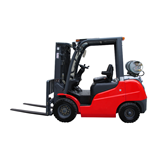
LPG | 2 min cylinder swap, continuous runtime | Mixed indoor/outdoor, multi-shift, variable hours |
Diesel | Highest torque, rough terrain capable | Outdoor yards, construction, unpaved surfaces |
Indoors on sealed concrete: choose electric. Outdoor, mixed-surface or 10+ hours per day: choose LPG or diesel.
Electric counterbalance (lead-acid or lithium): Zero on-site emissions and lower maintenance make this the default for enclosed facilities. Lead-acid requires a dedicated charging bay with ventilation; lithium-ion eliminates this but adds $8,000–$15,000 upfront. The electric forklift capacity guide covers specification detail.
LPG counterbalance: The right specification when battery charging logistics create productivity constraints. Cylinder swap takes under two minutes. Carbon monoxide exposure limits apply in enclosed spaces under WHS Regulations 2017. The LPG forklift buying guide covers fuel-specific compliance.
Evaluate the key specifications
With your fuel type confirmed, these specs determine whether a given model fits your operation.
Specification | Typical Range | Buyer Consideration |
|---|---|---|
Rated capacity | 3,000 kg at 500 mm load centre | Capacity drops with extended loads or attachments - a side-shift reduces effective capacity by 100–200 kg |
Lift height (max) | 3,000–7,000 mm | Match to your highest rack beam plus 150 mm clearance; every 1,000 mm above 4,500 mm reduces rated capacity |
Mast type | 2-stage / 3-stage / full free lift | Full free lift is required for container entry - collapsed height must clear the door header |
Turning radius | 2,100–2,400 mm | Determines minimum aisle width; measure your narrowest aisle before specifying |
Tyre type | Cushion / pneumatic / solid pneumatic | Cushion for smooth indoor floors only; pneumatic or solid pneumatic for outdoor or uneven surfaces |
Fork length | 1,070 mm (standard) to 1,800 mm | Standard Australian pallet is 1,165 × 1,165 mm - confirm your most common load dimensions |
The most common mistake is specifying lift height without checking capacity at elevation. A 3 tonne unit lifting 2,800 kg to 6,000 mm may exceed safe rated capacity at height.
Understand the full cost breakdown (2026 prices)
Purchase price is only part of the picture - cost models that miss the running cost layer get rejected at approval stage. Here is the full breakdown.
Category | Price Range (AUD) | Typical Configuration |
|---|---|---|
Entry-level electric | $30,000–$40,000 | Lead-acid battery, 2-stage mast, basic cabin |
Mid-range LPG/electric | $42,000–$55,000 | 3-stage mast, side-shift, integrated safety systems |
High-spec lithium/diesel | $55,000–$70,000 | Lithium-ion battery or heavy-duty diesel, full cabin, telematics |
Used (serviceable) | $15,000–$30,000 | Under 5,000 hours, recent service history, known brand |
Annual maintenance | $3,500–$8,000 | Servicing, tyres, wear parts; higher for LPG/diesel due to engine servicing |
Battery replacement (electric) | $6,000–$12,000 (lead-acid) / $15,000–$22,000 (lithium) | Typically required at 5–7 years for lead-acid; 8–10 years for lithium |
Over 5 years at 1,500 hours per year single-shift, a mid-range electric 3 tonne forklift costs $75,000–$95,000 total (purchase, maintenance, energy, one battery replacement). An equivalent LPG unit runs $80,000–$110,000 due to higher fuel and servicing. Electric breaks even against LPG at around 1,200 hours per year indoors - below that, LPG's lower purchase price wins; above it, electric's running cost advantage compounds each year. If you are within 3 months of purchasing, get quotes for 3 ton forklifts now - lead times on popular models stretch to 8–12 weeks.
Plan the asset - depreciation and financing
Forklifts are depreciable assets under ATO rules with an effective life of 11 years, giving a diminishing value rate of 18.18% or prime cost rate of 9.09%. The instant asset write-off threshold is $20,000 (2024-25) - most new 3 tonne units exceed this, so standard depreciation applies.
A $50,000 mid-range unit financed over 5 years at 7–9% typically runs $950–$1,100 per month. Residual value at 8–10 years sits around 15–25% of purchase price for well-maintained units. For unproven volume, a 12-month hire-to-own arrangement at $1,400–$1,800/month lets you validate utilisation before committing.
Evaluate suppliers
You are ready to go to market. Use this checklist to assess each supplier against the same criteria.
Factor | What to Ask |
|---|---|
Rated capacity at height | What is the effective capacity at my maximum required lift height with a side-shift fitted? |
Mast configuration | Does the collapsed mast height clear my lowest door header or container opening? |
Battery/fuel system | What is the expected runtime per shift, and what charging or refuelling infrastructure is required? |
Warranty terms | What does the warranty cover (powertrain, battery, hydraulics), for how long, and are wear parts included? |
Service network | Do you have a service technician within 4 hours of my site? What is the guaranteed response time? |
Spare parts availability | Are common wear parts (tyres, forks, seals, filters) stocked in Australia or imported to order? |
Delivery lead time | What is the current lead time for this model? Is a loan unit available during any delay? |
Operator training | Is operator familiarisation included at delivery? Does it cover site-specific hazards? |
Hire and rent-to-own | Do you offer short-term hire or hire-to-own? What is the monthly rate for a 3 tonne unit? |
Resale and trade-in | Do you buy back or offer trade-in on existing units? What valuation method do you use? |
Australian compliance requirements
- All operators must hold a current HRWL Class LF issued by the state WHS regulator (SafeWork NSW, WorkSafe VIC, Workplace Health and Safety QLD). No exemptions, including on private property.
- Forklifts are classified as plant under WHS Regulations 2017. Pre-start inspections before every shift and formal periodic inspections every 6–12 months are mandatory.
- Plant registration must be current before operation. LPG fuel systems require annual inspection and certification under AS 4983-2010.
- Maintenance records must be retained for WHS audit. The PCBU holds legal responsibility for ongoing compliance.
Frequently asked questions
What should i budget for a new 3 ton forklift in Australia?
New 3 tonne forklifts range from $30,000 for entry-level electric to $70,000 for high-spec lithium or diesel with full cabin. Mid-range models with 3-stage mast and side-shift sit between $42,000 and $55,000.
When should i choose electric over LPG for a 3 tonne unit?
Electric is the lower-TCO option for single-shift indoor operations running under 1,500 hours per year on sealed concrete. If your site is outdoor, multi-shift, or lacks charging infrastructure, LPG delivers continuous runtime without the battery management overhead.
How does rated capacity change with attachments and lift height?
A side-shift reduces effective capacity by 100–200 kg, and lifting above 4,500 mm reduces it further depending on mast geometry. Request the capacity chart at your specific lift height and attachment combination before purchase.
What ongoing compliance obligations apply after purchase?
Pre-start inspections before every shift, formal periodic inspections every 6–12 months, current HRWL Class LF for all operators, and plant registration with the state WHS regulator. LPG units also require annual gas system certification under AS 4983-2010.
Is hiring a 3 ton forklift more cost-effective than buying?
Short-term hire at $400–$600 per week suits project-based use under 12 months. For ongoing operations at 1,200+ hours per year, purchasing or hire-to-own delivers lower cost per hour within 18–24 months when finance options are factored in.
What matters most
- Fuel type is the first decision - it sets price bracket, running costs and infrastructure requirements.
- New 3 tonne forklifts cost $30,000–$70,000; used units start from $15,000.
- Specify mast height to your actual racking - over-specifying adds cost and reduces capacity at height.
- 5-year TCO runs $75,000–$110,000 depending on fuel type and utilisation.
- HRWL Class LF licensing, pre-start inspections and plant registration are non-negotiable.
- Request capacity charts at your specific lift height and attachment combination before signing off.
Most buyers shortlist 2–4 models after getting an initial quote.
Do not waste time contacting suppliers individually. IndustrySearch gives you direct access to verified Australian 3 ton forklift suppliers - where industrial buyers request and compare multiple quotes so they can buy with confidence.
- Get quotes for 3 ton forklifts - contact multiple verified suppliers with a single enquiry
- Compare models - filter by capacity, configuration and region
- Contact suppliers directly - speak to specialists who service your state
? Get and compare 3 ton forklift quotes now ?

-160x160-state_article-rel-cat.png)




-160x160-state_article-rel-cat.png)