
Key takeaways
- Price range (2026): Spring-operated pallet levellers cost $2,000-$6,000; pneumatic models cost $4,000-$8,000; hydraulic models cost $5,000-$10,000+ in Australia.
- Primary decision factor: Load consistency - spring-operated levellers work best when every pallet carries products of similar weight per layer. Variable loads need pneumatic or hydraulic.
- If your team hand-loads 5+ pallets per day of the same product - a spring-operated leveller at $2,000-$4,000 is the simplest, lowest-maintenance solution available.
- Capacity range: 150-2,000 kg for spring and pneumatic models; up to 4,000+ kg for hydraulic. Match the spring set or air pressure to your typical full-pallet weight.
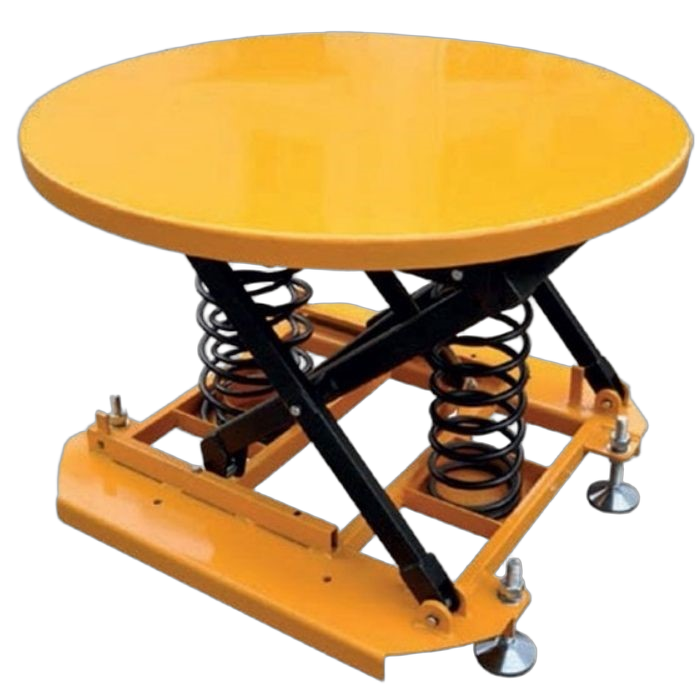
- Turntable option: A built-in turntable ($300-$800 extra) allows the operator to rotate the pallet 360 degrees without walking around it - eliminating reaching injuries on the far side.
- WHS obligation: Under the WHS Act 2011, PCBUs must eliminate or minimise manual handling risks so far as reasonably practicable. A pallet leveller directly addresses the repetitive bending identified in Safe Work Australia's Hazardous Manual Tasks Code of Practice.
- Washdown environments: Food, beverage and pharmaceutical sites require stainless steel or galvanised washdown-rated models - standard painted steel will corrode within 12 months in wet environments.
The warehouse manager's guide to buying a pallet leveller (2026)
A pallet leveller keeps the top of the load at a consistent working height as products are added or removed - replacing the repetitive bending and reaching that drives musculoskeletal injuries in manual pallet loading operations. Spring-operated models do this automatically with no power source, no operator controls and near-zero maintenance. For Australian warehouses, production lines and distribution centres where manual pallet handling is part of the daily workflow, the pallet leveller is the lowest-cost, highest-compliance manual handling intervention available under the WHS Act 2011.
This guide walks warehouse managers, WHS officers and procurement leads through configuration, specifications, pricing and supplier evaluation for pallet levellers in Australia. If you already know your configuration, get quotes for pallet levellers from verified Australian suppliers on IndustrySearch.
Operations where pallet levellers are the standard choice:
- Warehouse pick-and-pack stations hand-loading outbound pallets
- End-of-line packaging stations in food, beverage and FMCG manufacturing
- Cold storage and freezer operations where manual handling fatigue accelerates in PPE
- Pharmaceutical and medical device warehouses with strict ergonomic compliance requirements
- Distribution centres processing 20+ pallets/day across multiple loading points
Choose your configuration
Before costing anything, confirm which leveller type suits your load profile and site infrastructure. Your choice here sets your price bracket, maintenance profile and operator workflow.
Type | Key Spec | Best For |
|---|---|---|
Spring-operated |
500-2,000 kg, no power, automatic levelling, lifetime spring warranty |
Consistent product weight per layer - cartons, bottles, cans, bags of uniform size |
Pneumatic |
500-2,000 kg, compressed air, adjustable levelling force |
Mixed product weights or where levelling force needs adjustment between pallet types |
Hydraulic |
1,000-4,000+ kg, electric-hydraulic, push-button control |
Heavy-duty loads, precise height control, or integration with conveyor systems |
If 80%+ of your pallets carry the same product at consistent weight per layer, spring-operated is the correct choice. Mixed-weight operations running 5+ different product types across the same leveller station should evaluate pneumatic for the adjustable levelling force.
Evaluate the key specifications
With your configuration confirmed, these are the specs that determine whether a given model fits your operation and delivers the ergonomic benefit.
Specification | Typical Range | Buyer Consideration |
|---|---|---|
Load capacity |
150-4,000+ kg |
Match to your heaviest full-pallet weight plus 10% margin - under-rated levellers bottom out before the pallet is full |
Platform size |
1,000 x 1,000mm to 1,200 x 1,200mm |
Must accommodate your standard pallet footprint - Australian standard is 1,165 x 1,165mm (CHEP) |
Travel height |
600-800mm |
Sufficient travel keeps the top layer at waist height (800-1,000mm from floor) through the full load cycle |
Turntable |
Built-in or none |
Turntable gives 360-degree pallet access - eliminates reaching to the far side. Essential for single-operator stations. |
Surface finish |
Galvanised, powder-coated or stainless steel |
Galvanised suits dry warehouses; stainless is required for food, beverage and pharmaceutical washdown environments |
Fork pocket access |
2-way or 4-way |
4-way access allows forklift repositioning from any direction - saves time in tight floor layouts |
Shock absorber |
Standard on quality models |
Prevents platform bounce when heavy items are placed - protects product and reduces operator startle |
Understand the full cost breakdown (2026 prices)
Purchase price is almost the entire cost of ownership for spring-operated pallet levellers. The ongoing expense profile is among the lowest of any warehouse equipment category.
Category | Price Range (AUD) | Typical Configuration |
|---|---|---|
Spring-operated (new) |
$2,000-$6,000 |
500-2,000 kg, galvanised, turntable optional, fork pockets, shock absorber |
Pneumatic (new) |
$4,000-$8,000 |
Requires compressed air supply, adjustable force, suits variable weights |
Hydraulic (new) |
$5,000-$10,000+ |
Electric-hydraulic, push-button or foot pedal, heavy-duty applications |
Stainless steel upgrade |
Add 30-50% |
Required for food, beverage and pharma washdown environments |
Turntable add-on |
$300-$800 |
360-degree pallet rotation - eliminates far-side reaching |
Annual maintenance (spring) |
$0-$200 |
Turntable bearing lubrication and visual inspection only |
The most common mistake is buying a leveller without a turntable for single-operator pallet loading stations. Without rotation, the operator still reaches across the pallet to place items on the far side - reducing but not eliminating the injury risk the leveller was purchased to address. A turntable at $300-$800 closes that gap completely. For spring-operated models at $2,000-$6,000, get quotes for pallet levellers from verified Australian suppliers.
Plan the asset (depreciation and financing)
The ATO effective life for materials handling equipment is 10 years. Under diminishing value, the depreciation rate is 20%; prime cost is 10% per annum. All spring-operated and most pneumatic pallet levellers fall under the $20,000 instant asset write-off threshold for eligible small businesses.
Spring-operated pallet levellers retain 30-50% residual value at 8-10 years due to minimal mechanical wear. For operations deploying 5+ units across a warehouse floor, fleet purchasing typically attracts 10-15% volume discounts from Australian suppliers.
Evaluate suppliers
You are ready to go to market. Use this checklist to assess each supplier against the same criteria.
Factor | What to Ask |
|---|---|
Spring configuration |
Can you configure the spring set to match my specific product weight and pallet height profile? |
Spring warranty |
Do you offer a lifetime spring warranty? What does the frame warranty cover and for how long? |
Platform sizing |
Does the platform accommodate standard CHEP pallets (1,165 x 1,165mm)? |
Turntable |
Is a built-in turntable available and what is the additional cost? |
Washdown rating |
Is a stainless steel or washdown-rated version available for my environment? |
Demo or trial |
Can I trial a unit on my production line with my actual product before committing to a fleet order? |
Delivery and setup |
Is delivery and spring configuration included in the quoted price? |
Fleet pricing |
Is there a volume discount for purchasing 3+ units? |
Lead time |
Is this model ex-stock in Australia or manufactured to order? |
WHS documentation |
Can you provide a risk assessment or ergonomic improvement template for my WHS submission? |
Frequently asked questions
What load capacity pallet leveller does a typical warehouse need?
Most standard pallet loading applications fall in the 500-1,500 kg range. Match the spring set to your typical full-pallet weight - a 1,200 kg rated leveller handles most FMCG, food and general warehouse carton palletising.
Do spring-operated pallet levellers require any maintenance?
Effectively none. Springs are set at installation and carry lifetime warranties on quality Australian brands. The only maintenance item is occasional turntable bearing lubrication if fitted, costing under $200/year.
When should i choose pneumatic over spring-operated?
When your pallet loading station handles products of significantly different weights across shifts - for example, alternating between 5 kg cartons and 20 kg bags. Pneumatic levellers let you adjust the levelling force to match each product type without changing springs.
Can a pallet leveller be used in a cold storage environment?
Yes. Spring-operated levellers perform well in cold storage because they have no hydraulic fluid to thicken, no electrical components to condense and no air lines to freeze. Choose galvanised or stainless steel construction for corrosion resistance in humid cold rooms.
What WHS regulations does a pallet leveller address?
The WHS Act 2011 and Hazardous Manual Tasks Code of Practice require PCBUs to minimise manual handling risks. A pallet leveller directly addresses repetitive bending and reaching during pallet loading - documented as a primary musculoskeletal injury driver in Safe Work Australia data.
What matters most
- Spring-operated levellers at $2,000-$6,000 suit 90% of standard pallet loading applications with consistent product weight
- Match the spring set to your product weight at installation - incorrect springs cause uneven levelling and reduce ergonomic benefit
- A turntable at $300-$800 is not optional for single-operator stations - without it, far-side reaching remains an injury risk
- Stainless steel is required for food, beverage and pharmaceutical washdown environments
- Near-zero running cost and lifetime spring warranties make pallet levellers one of the lowest-TCO warehouse investments
- WHS Act 2011 obligations make pallet levellers a compliance investment, not just an ergonomic one
Most buyers shortlist 2-3 models after getting an initial quote.
Don't waste time contacting suppliers individually. IndustrySearch gives you direct access to verified Australian pallet leveller suppliers - where industrial buyers request and compare multiple quotes so they can buy with confidence.
- Get quotes for pallet levellers - contact multiple verified suppliers with a single enquiry
- Compare models - filter by capacity, type and region
- Contact suppliers directly - speak to specialists who service your state
→ Get and compare pallet leveller quotes now → https://www.industrysearch.com.au/buy/pallet-leveller