-720x400.jpg)

-720x400.jpg)
-720x400.jpg)

Manufacturing components for the electric vehicle and new energy industries often involves stamping, cutting and forming processes that generate aluminum offcuts. For high-volume manufacturers, the challenge is not only recovering the scrap, but also managing the space occupied by loose material.
This case involves a component manufacturer supplying EV, battery and electric motor companies. With approximately 1.3 tons of aluminum scrap generated per hour, the customer needed a practical way to reduce the bulk volume of its production scrap.
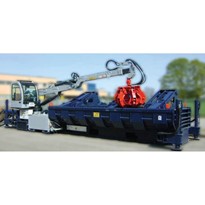
A hopper-type aluminum scrap baler was introduced to handle the loose offcuts and convert them into compact bales.
Customer Background
The customer is a component manufacturer serving several areas of the new energy supply chain.
For electric vehicle manufacturers, the company supplies motor cores for both pure electric and hybrid platforms.
For battery manufacturers, the company produces precision structural components for lithium battery applications. It entered the lithium battery precision structural parts sector around the end of 2015 and has since supplied components to new energy battery companies.
The company also maintains stable cooperation with established electric motor manufacturers, supplying drive motor cores and other key components.
As part of these manufacturing operations, aluminum offcuts are generated continuously during production.
Key Application Facts
Item | Details |
|---|---|
Industry | EV, battery and electric motor component manufacturing |
Material | Aluminum offcuts |
Generation rate | Approx. 1.3 t/h |
Main requirement | Volume reduction |
Equipment | Hopper-type metal baler |
Result | Volume reduction requirement solved |
The Production Challenge
The customer's main issue was the bulk volume of loose aluminum scrap generated during production.
At approximately 1.3 tons per hour, the amount of material generated was significant. While the aluminum retained recycling value, loose offcuts were not an efficient form for storage and handling.
The customer therefore needed a solution that could be incorporated into its existing scrap collection process without treating the aluminum as ordinary waste.
The requirement was straightforward:
Compress the loose aluminum scrap into a more compact form before further storage, handling or recycling.
The Solution: Hopper-Type Aluminum Scrap Baler
The customer selected a hopper-type metal baler for the application.
The hopper provides a convenient way to feed loose aluminum offcuts directly into the baling chamber. This is particularly useful for production scrap consisting of irregular pieces that are generated continuously rather than arriving in uniform batches.
Once loaded, the hydraulic system compresses the aluminum scrap into compact bales.
The process can be summarized as:
Production ? Scrap Collection ? Hopper Feeding ? Hydraulic Compression ? Compact Aluminum Bales
This configuration allows scrap handling to become part of the production workflow instead of requiring loose material to remain accumulated around the workshop.
How the Baling Process Works in This Application
The aluminum offcuts are first collected from the production process.
Depending on the plant's material-handling arrangement, the scrap can then be transferred to the baler's hopper. The hopper acts as the receiving point for the loose material.
The hydraulic compression cycle then reduces the material's bulk volume and forms it into a more manageable bale.
The resulting bales are easier to organize than loose offcuts and can be moved to the next stage of the customer's recycling or material-handling process.
The important point is that the baler is not being used to change the value of the aluminum. It changes the physical form of the scrap, making the material more compact and manageable.
Result: The Volume Reduction Requirement Was Solved
The customer's original objective was to reduce the volume occupied by loose aluminum scrap.
After implementing the baling solution, this requirement was successfully addressed.
The customer could compress the production offcuts into compact bales rather than continuing to manage them in loose form.
The result was a more practical scrap-handling process, with the baled aluminum easier to organize and move within the facility.
No specific percentage of volume reduction is stated here because the actual result depends on the material shape, size, loading conditions and baling configuration.
Why This Application Is Relevant to Similar Manufacturers
The same type of scrap-management challenge can occur in other manufacturing operations where aluminum offcuts are generated as part of production.
Potential applications include:
EV motor component manufacturing
Electric motor core production
Lithium battery structural component manufacturing
Aluminum stamping plants
Aluminum sheet cutting and trimming
Automotive component production
New energy equipment manufacturing
In these environments, the aluminum is not necessarily the primary product being processed. It is a by-product of manufacturing that still has recycling value.
For this reason, an aluminum scrap baler can serve as a practical connection between the production line and the downstream recycling process.
Choosing an Aluminum Scrap Baler for Production Scrap
The appropriate baler should be selected according to the actual production conditions.
Material Characteristics
Start with the physical characteristics of the aluminum scrap.
Important factors include:
Scrap dimensions
Material thickness
Piece shape
Whether the material is flat, irregular or mixed
Whether other materials are present
Scrap Generation Rate
The amount of scrap generated is one of the most important selection factors.
Manufacturers should provide their typical hourly or daily production volume so that the baler capacity can be matched to the application.
For this case, the reference production rate was approximately 1.3 tons per hour.
Feeding Arrangement
The feeding method should also be considered.
A hopper-type configuration can be useful when the material is generated as loose production scrap and needs to be collected before compression.
The available feeding equipment, operator workflow and plant layout should all be considered during the design stage.
Bale Requirements
The required bale dimensions and density depend on how the compressed aluminum will be stored, handled and recycled.
If the customer already has transportation or downstream recycling requirements, these should be considered before selecting the machine.
A Manufacturing Scrap Solution, Not Just a Baling Machine
This case demonstrates a common situation in modern component manufacturing: the primary production process may be highly automated, while scrap handling can remain relatively inefficient.
For this customer, the key requirement was not simply to purchase a metal baler. The equipment needed to fit the way aluminum offcuts were generated and collected.
The hopper-type configuration provided a practical interface between loose production scrap and hydraulic compaction.
As a result, the customer was able to address the original volume reduction requirement while creating a more manageable form of aluminum scrap for subsequent handling.
Frequently Asked Questions
What is an aluminum scrap baler?
An aluminum scrap baler is a hydraulic machine used to compress loose aluminum scrap into compact bales for easier storage, handling and recycling.
Can an aluminum scrap baler process stamping offcuts?
Yes. Aluminum stamping offcuts can be baled when the material characteristics are compatible with the selected machine. Material size, thickness and shape should be evaluated before equipment selection.
What is a hopper-type metal baler?
A hopper-type metal baler uses a receiving hopper to accept loose scrap before it is compressed by the hydraulic baling system. It can be suitable for production environments where scrap is continuously generated and collected.
How much aluminum scrap can a baler process?
The required capacity depends on the customer's actual scrap generation rate, operating schedule and material characteristics. In this case, the customer generates approximately 1.3 tons of aluminum scrap per hour.
Is an aluminum scrap baler suitable for EV component manufacturers?
It can be suitable for EV and new energy component manufacturers that generate aluminum offcuts during stamping, cutting, trimming or other production processes.
Can I test my aluminum scrap before selecting a baler?
Yes. Material testing can help evaluate feeding behavior, compression performance and the suitability of a particular baling configuration for the customer's actual scrap.
Looking for an Aluminum Scrap Baling Solution?
If your production process generates aluminum offcuts, stamping scrap or other loose aluminum scrap, the right baling system can help you integrate scrap volume reduction into your existing workflow.
To evaluate an application, provide:
Photos or video of the aluminum scrap
Scrap generation rate per hour or day
Typical material dimensions
Desired bale size, if known
Current feeding method
Available installation space
Based on these details, a suitable aluminum scrap baler can be evaluated for your production process.
Contact us to discuss your aluminum scrap application or arrange a material test.




-205x205.jpg)
-205x205.jpg)

-205x205.jpg)

(1)-205x205.jpg)
-205x205.jpg)
-205x205.jpg)
-205x205.jpg)

-205x205.jpg)
-205x205.jpg)
-205x205.jpg)