
Key takeaways
- Pallet leveller price (2026): $2,000-$6,000 for spring-operated models; automatic levelling with no power source, no operator controls and near-zero maintenance.
- Scissor lift table price (2026): $1,500-$10,000+ for hydraulic or electric models; operator-controlled height adjustment via foot pump, push-button or foot pedal.
- Primary decision factor: Automation vs control. A pallet leveller adjusts height automatically as weight changes. A scissor lift table holds a fixed height until the operator changes it.
- If your task is pallet loading/unloading with consistent product weight - a pallet leveller is the right tool. If your task is workstation height adjustment, machine feeding or multi-purpose lifting - a scissor lift table is the right tool.
- Maintenance difference: Spring-operated pallet levellers have near-zero maintenance cost. Hydraulic scissor lift tables require annual fluid checks, seal inspection and pump service at $200-$600/year.
- Capacity overlap: Both handle 500-2,000 kg in standard configurations. Above 2,000 kg, scissor lift tables offer more options up to 90,000+ kg for heavy industrial applications.
- Common mistake: Buying a scissor lift table for pallet loading when a leveller does the job automatically at lower cost and zero energy. The operator should not have to push a button to adjust height during a repetitive loading cycle.
Pallet leveller vs scissor lift table: Which earns its place on your floor? (2026 comparison)
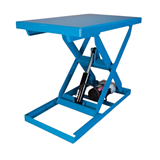
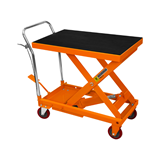
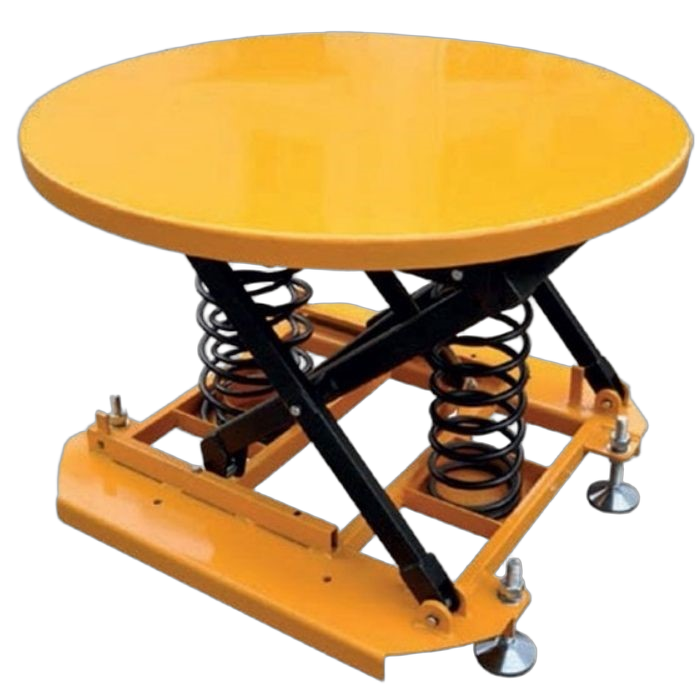
Pallet levellers and scissor lift tables look similar - both use scissor-leg mechanisms to raise a platform. But they solve different problems. A pallet leveller uses springs (or air/hydraulic pressure) to automatically adjust platform height as weight is added or removed - keeping the top of the load at waist height without operator input. A scissor lift table uses hydraulic or electric power to raise the platform to a fixed height set by the operator - holding that position regardless of load changes. Choosing the wrong one means either paying an operator to adjust height manually on a task that should be automatic (scissor lift for pallet loading) or expecting automatic levelling on a task that requires precise fixed-height positioning (pallet leveller for machine feeding).
This comparison puts both machines side by side on function, cost, maintenance and application for Australian warehouses, production lines and distribution centres. To compare pricing from verified suppliers, get quotes for pallet levellers or get quotes for scissor lift tables on IndustrySearch.
Operations where this comparison matters most:
- Warehouse operations specifying ergonomic equipment for pallet loading bays
- Production lines evaluating height-adjustable platforms for end-of-line packing or machine feeding
- WHS officers selecting manual handling controls under the Hazardous Manual Tasks Code of Practice
- Procurement managers comparing quotes that include both product types for the same application
Compare the core differences
Before comparing costs, confirm which machine type matches your primary task. The core difference is automatic vs operator-controlled height adjustment.
Factor | Pallet Leveller | Scissor Lift Table |
|---|---|---|
Height adjustment |
Automatic - platform rises/lowers as weight changes |
Operator-controlled - fixed height until manually adjusted |
Power source |
Springs (none), compressed air or hydraulic |
Hydraulic foot pump, electric-hydraulic or battery |
Primary task |
Pallet loading and unloading - keeping top layer at waist height |
Workstation height adjustment, machine feeding, load positioning, maintenance access |
Operator input during use |
None - fully automatic |
Required - pump, button or pedal to adjust height |
Turntable option |
Common - built-in for pallet rotation |
Uncommon - not a standard feature |
Annual maintenance |
$0-$200 (spring models) |
$200-$600 (hydraulic fluid, seals, pump service) |
Pallet leveller suits you if the task is repetitive pallet loading or unloading where the platform needs to move continuously as weight changes. The operator should never have to stop loading to adjust height - the leveller does it automatically.
Scissor lift table suits you if the task requires raising a load to a fixed working height - feeding a conveyor, positioning a workpiece at machine height, creating an adjustable workstation, or lifting heavy components for maintenance access. The operator sets the height once per task.
Evaluate the key specifications
With your primary task confirmed, these are the specs that determine whether a specific model fits your operation.
Specification | Typical Range | Buyer Consideration |
|---|---|---|
Load capacity |
Leveller: 150-2,000 kg; Table: 150-90,000+ kg |
Scissor lift tables offer far wider capacity range for heavy industrial applications |
Travel height |
Leveller: 600-800mm; Table: 300-2,100mm+ |
Scissor lift tables (especially double-scissor) reach much higher - suited for elevated work platforms |
Lowered height |
Leveller: 100-200mm; Table: 200-400mm |
Low-profile scissor tables suit floor-level pallet loading where forklifts place pallets directly onto the platform |
Platform accessories |
Leveller: turntable, fork pockets; Table: roller top, tilting platform, conveyor bed |
Scissor tables offer more accessory options for integration with conveyor systems and production lines |
Energy requirement |
Leveller (spring): zero; Table: 240V or 415V |
Spring levellers need no power point - deploy anywhere on the warehouse floor |
Understand the full cost comparison (2026 prices)
The cost gap narrows at purchase but widens over time due to the pallet leveller's near-zero ongoing cost.
Cost Category | Pallet Leveller (Spring) | Scissor Lift Table (Hydraulic) |
|---|---|---|
Purchase (new, mid-spec) |
$2,500-$5,000 |
$2,500-$8,000 |
Annual energy |
$0 |
$50-$300 (electric pump motor) |
Annual maintenance |
$0-$200 |
$200-$600 (fluid, seals, pump) |
5-year TCO |
$2,500-$6,000 |
$4,000-$12,500 |
Operator time per pallet |
Zero - automatic adjustment |
10-30 seconds per height change (pump or button) |
For pallet loading at 10+ pallets/day, the time spent manually adjusting a scissor lift table adds up to 15-30 minutes of non-productive operator time per shift. A spring-operated leveller at $3,000-$5,000 eliminates that entirely while also costing $1,000-$4,500 less in 5-year maintenance. For levellers at $2,000-$6,000, get quotes for pallet levellers or for scissor tables at $1,500-$10,000+, get quotes for scissor lift tables from verified Australian suppliers.
Decision framework - pallet leveller vs scissor lift table
Decision Factor | Choose Pallet Leveller | Choose Scissor Lift Table |
|---|---|---|
Primary task |
Pallet loading/unloading with weight changing continuously |
Fixed-height positioning, machine feeding, workstation adjustment |
Height adjustment needed |
Continuous automatic (as load weight changes) |
Discrete manual (set height, hold, work, reset) |
Power available |
Not required (spring models) |
240V or 415V required for electric-hydraulic |
Load weight |
Under 2,000 kg (standard pallet loads) |
Up to 90,000+ kg for heavy industrial |
Maintenance tolerance |
Minimal - near-zero ongoing cost preferred |
Acceptable - $200-$600/year in scheduled service |
Evaluate suppliers
You are ready to go to market. Use this checklist to assess each supplier against the same criteria.
Factor | What to Ask |
|---|---|
Application suitability |
Is a pallet leveller or scissor lift table the correct solution for my specific task? |
Load capacity |
Does this unit handle my maximum load weight with appropriate margin? |
Travel range |
Does the travel height keep my working surface at the ergonomic target through the full cycle? |
Warranty |
What warranty covers the mechanism (springs, hydraulics, pump)? |
Maintenance schedule |
What annual servicing is required and what is the estimated cost? |
Platform options |
Is a turntable, roller top or tilting platform available for my application? |
Washdown rating |
Is a stainless or washdown-rated version available for my environment? |
Demo |
Can I trial this unit on my production line before purchasing? |
Lead time |
Is this model ex-stock in Australia or manufactured to order? |
Fleet pricing |
Is there a volume discount for purchasing multiple units? |
Frequently asked questions
Can a scissor lift table do the same job AS a pallet leveller?
Only with manual operator input at every height change. A scissor lift table holds a fixed height until the operator adjusts it - adding 10-30 seconds of non-productive time per adjustment. For repetitive pallet loading, a pallet leveller is faster and requires no operator intervention.
When is a scissor lift table the better choice?
When the task requires precise fixed-height positioning: feeding a conveyor at a specific height, creating an adjustable workstation, positioning heavy components for assembly, or lifting equipment for maintenance access. These tasks need the platform to hold a set height regardless of load changes.
What is the maintenance cost difference over five years?
A spring-operated pallet leveller costs $0-$1,000 in maintenance over 5 years. A hydraulic scissor lift table costs $1,000-$3,000 over the same period in fluid changes, seal replacements and pump servicing. The gap increases with higher usage frequency.
Do both machines meet WHS manual handling requirements?
Both reduce bending and reaching during manual handling tasks. For pallet loading specifically, the pallet leveller provides a stronger WHS case because the ergonomic benefit is automatic and continuous - the operator cannot forget or neglect to adjust the height.
Can i use both in the same warehouse?
Yes - many warehouses deploy pallet levellers at loading stations and scissor lift tables at workstations, machine-feeding points and maintenance bays. Each machine serves a different task type, and using both maximises ergonomic coverage across the floor.
What matters most
- Pallet levellers adjust height automatically as load weight changes - scissor lift tables hold a fixed height set by the operator
- For repetitive pallet loading, a leveller is faster, cheaper to maintain and provides continuous ergonomic benefit without operator input
- For fixed-height positioning, machine feeding and workstation adjustment, a scissor lift table is the correct tool
- 5-year TCO for a spring leveller ($2,500-$6,000) is 40-50% lower than a comparable scissor lift table ($4,000-$12,500)
- Many warehouses deploy both - levellers at loading stations, scissor tables at workstations
- Both product types are available from verified Australian suppliers on IndustrySearch
Most buyers shortlist 2-3 models after getting an initial quote.
Don't waste time contacting suppliers individually. IndustrySearch gives you direct access to verified Australian materials handling suppliers - where industrial buyers request and compare multiple quotes so they can buy with confidence.
- Get quotes for pallet levellers - contact multiple verified suppliers with a single enquiry
- Get quotes for scissor lift tables - compare models, capacities and pricing
- Contact suppliers directly - speak to specialists who service your state
→ Get and compare pallet leveller quotes now → https://www.industrysearch.com.au/buy/pallet-leveller