

The signage and display market continues to evolve, driven by growing demand for shorter production runs, customised products and faster turnaround times. Whether producing retail displays, exhibition graphics, point-of-sale materials or promotional signage, businesses are expected to deliver high-quality results with greater speed and efficiency than ever before.
To meet these expectations, many signmakers are looking beyond individual pieces of equipment and focusing instead on the efficiency of their entire production workflow.
The challenge for accurate finishing
For printed signage, achieving vibrant graphics is only part of the equation. The finished product must also be cut accurately, with clean edges and precise alignment between the printed design and final shape.
Traditional production methods often involve multiple handling steps, manual positioning or the use of jigs to align materials. While these approaches can be effective, they may also introduce setup delays, alignment errors and unnecessary waste—particularly when producing a variety of short-run jobs.
As customer expectations rise, even small inefficiencies can impact profitability and production capacity.
Why more signmakers are automating the process
?To improve consistency and productivity, many manufacturers are adopting integrated print-and-cut workflows that connect digital printing and contour cutting into a seamless production process.
These systems use printed registration marks and vision-based positioning technology to automatically identify the location of the artwork before cutting begins. By compensating for material movement or minor distortions, the software helps ensure contour cuts remain accurately aligned with the printed design.
The result is a more reliable workflow that reduces manual intervention and delivers consistent results across a wide range of applications.
Benefits for high-mix production environments
For signmakers producing a mix of customised jobs, workflow efficiency is often just as important as cutting speed.
An integrated print-and-cut workflow can offer:
These benefits become increasingly valuable as businesses take on more personalised, short-run and on-demand work.
Building a connected production workflow
Successful sign production relies on the smooth integration of design, printing and finishing processes.
Modern workflow software helps connect these stages by streamlining job preparation, improving communication between systems and reducing operator workload. This allows production teams to process jobs more efficiently while maintaining the accuracy and repeatability required for professional signage applications.
As labour shortages and production demands continue to challenge the industry, automation is becoming an important part of maintaining both productivity and competitiveness.
How Trotec supports print-and-cut production
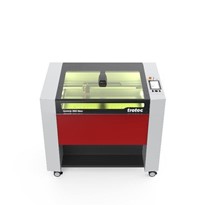
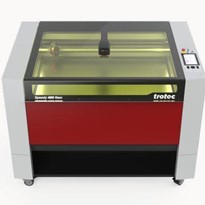
Trotec's Print & Cut workflow combines Ruby® workflow software, the Vision Print & Cut system and Speedy laser cutters to support accurate contour cutting of digitally printed materials.
By automatically detecting printed registration marks and positioning the design for cutting, the workflow reduces manual adjustments while helping to ensure precise alignment between printing and finishing.
The solution is well suited to applications such as:
For businesses seeking to improve efficiency and consistency, integrated workflows such as Print & Cut provide a practical way to streamline production while maintaining high-quality results.
- Retail displays
- Point-of-sale signage
- Exhibition and event graphics
- Printed acrylic products
- Promotional displays
- Custom signage and branding elements
- Reduced setup times
- Less material waste
- Fewer production errors and reprints
- Improved edge quality
- Greater accuracy on complex shapes
- Faster turnaround times
- Increased production consistency


-160x160-state_article-rel-cat.png)


-160x160-state_article-rel-cat.png)


-160x160-state_article-rel-cat.png)