
-720x400.jpg)
-720x400.jpg)
-720x400.jpg)
-720x400.jpg)
-720x400.jpg)
-720x400.jpg)

Customer Background
An Australian scrap metal recycler was handling a growing volume of aluminum extrusion profiles.
The company had previously relied on a manual metal baler. As the business expanded, the existing equipment could no longer keep up with the required workload. Manual feeding and pressing also meant more operator involvement and limited the ability to increase daily production.
The customer was looking for an automatic Aluminum Extrusion Baler capable of handling approximately 10 tonnes of aluminum profiles per day.
Customer Requirement
Item | Requirement |
|---|---|
Material | Aluminum extrusion profiles |
Daily volume | Approx. 10 tonnes/day |
Existing equipment | Manual metal baler |
New requirement | Automatic baling |
Application | Scrap metal recycling |
The priority was not simply a higher press force. The new machine needed to handle long aluminum extrusion profiles, reduce manual preparation and provide enough capacity for the customer's growing daily volume.
Equipment Selected
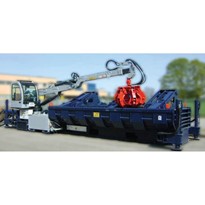
ENERPAT selected the AMB-L2014-250T Aluminum Extrusion Baler for the application.
The machine combines a 250-ton main ram, 2 × 125-ton side rams and a 2000 × 1400 × 900 mm press chamber. Its rated capacity for aluminum profiles is 1–1.5 tonnes per hour.
Key Features for Aluminum Extrusions
Built-in shearing blades
The press chamber is equipped with shearing blades at the edges, allowing long aluminum extrusion profiles to be cut during the compression process. This can reduce the need for separate pre-cutting before baling.
4:1 high compression ratio
The machine is designed to achieve a high compression ratio, producing compact and consistent bales. For Australian recyclers, reducing the volume of loose aluminum scrap can help make better use of storage and transport capacity.
Cold pressing
The aluminum is compacted hydraulically without binders or heating. This keeps the process simple and avoids adding foreign materials to the scrap.
Industrial hydraulic cooling
An industrial chiller helps control hydraulic oil temperature during extended operation and is suitable for demanding, multi-shift production environments.
Siemens and Schneider components
The electrical control system uses globally recognized components, including Siemens motors and Schneider control components, helping simplify operation and maintenance.
AMB-L2014-250T Specifications
Item | Specification |
Model | AMB-L2014-250T |
Main Ram Press Force | 250 T |
Side Ram Press Force | 2 × 125 T |
Press Chamber | 2000 × 1400 × 900 mm |
Motor | 2 × 22 kW / 2 × 30 HP |
Pump | 2 × 160 ml/r |
Bale Size | 400 × 400 mm |
Cycle Time | Approx. 120 s |
Aluminum Profile Capacity | 1–1.5 t/h |
Steel Capacity | Up to 5 t/h |
Machine Size | 5500 × 4500 × 2800 mm |
Machine Weight | Approx. 20 tonnes |
Performance Comparison
The equipment change was driven by the need to move from manual baling to a higher-capacity automatic process.
Indicator | Previous Manual Baling | AMB-L2014-250T |
Aluminum profile processing | Limited by manual operation | 1–1.5 t/h rated capacity |
Daily production target | Increasing volume exceeded existing capability | Approx. 10 t/day application |
Operation | Manual | Automatic hydraulic compression |
Long profile preparation | Manual cutting may be required | Built-in shearing blades |
Bale format | Dependent on previous equipment | Standard 400 × 400 mm bales |
Compression | Manual equipment dependent | 250 T main ram + 2 × 125 T side rams |
Note: The AMB-L2014-250T figures are manufacturer-rated specifications. Actual throughput, labour requirements and bale density depend on material length, loading method, bulk density, operating hours and site conditions.
For Australian Scrap Metal Recyclers
Aluminum extrusion scrap can occupy considerable space when stored loose. Compacting it into standardized bales can make handling, stacking and transportation more manageable.
This is particularly relevant to Australian recycling operations, where scrap may need to travel significant distances between collection sites, processing facilities and downstream buyers.
The right Aluminum Scrap Baler should therefore be selected according to the actual material, daily volume, available labour, bale requirements and site conditions—not press force alone.
For Australian recyclers facing similar capacity challenges, ENERPAT offers material testing and site assessments to help validate the right model before purchase.
If you are currently using a manual baler and your aluminum extrusion volume is increasing, send us your material type, daily tonnage, current equipment and required bale size. ENERPAT can recommend an aluminum extrusion baling machine based on the actual application.
-160x160-state_article-rel-cat.png)


-160x160-state_article-rel-cat.png)


-205x205.jpg)
-205x205.jpg)

-205x205.jpg)
-205x205.jpg)
-205x205.jpg)
-205x205.jpg)
-205x205.jpg)
-205x205.jpg)
-205x205.jpg)

-205x205.jpg)
-205x205.jpg)
-205x205.jpg)
(1)-205x205.jpg)
-205x205.jpg)


-205x205.jpg)

