
Key takeaways
Direct-drive (vehicle-powered) units run off the truck's engine. They are lighter and quieter, but only cool while the engine runs, unless you plug them into standby power.
Self-powered diesel units have their own engine, so they hold temperature with the truck switched off. They suit large bodies, frozen loads and long stops away from power.
Weight matters for payload: Thermo King says its V-1000 vehicle-powered unit weighs under half an equivalent diesel unit, saving 150kg to 250kg depending on standby.
Standby power is the option most buyers under-spec: decide between 240V single-phase and 415V three-phase based on what your depot can supply.
Freezer work needs a freezer-rated unit: a chiller unit cannot reliably pull a body down to -18°C. Check the unit's rating, not just the body's.
What is the difference between a direct-drive and a diesel fridge unit?
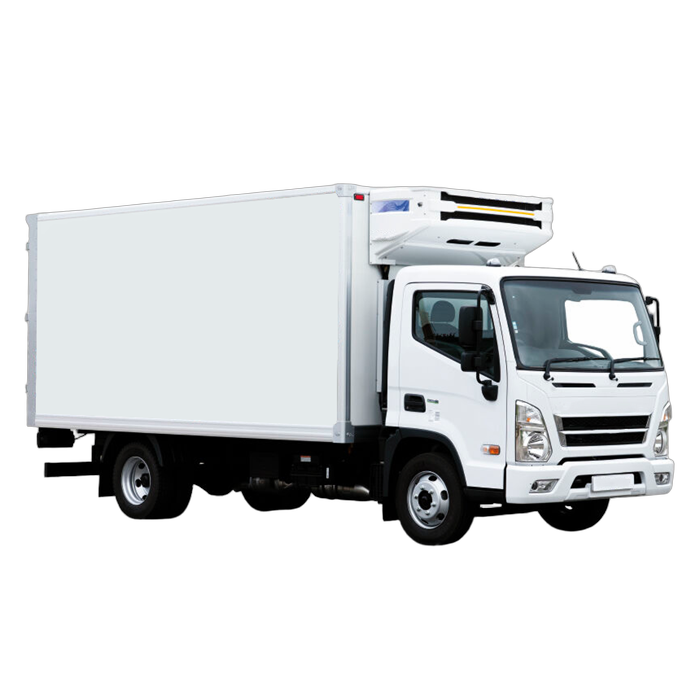
A direct-drive unit uses a compressor driven by the truck's own engine, much like a car's air conditioning. A self-powered unit has its own small diesel engine and runs independently of the truck.
That single difference drives most of the trade-offs:
Factor | Direct-drive (vehicle-powered) | Self-powered diesel |
|---|---|---|
Cooling with truck engine off | Only on standby power | Yes |
Cooling capacity | Varies with engine speed | Constant |
Weight | Lighter | Heavier |
Noise at the unit | Low | Higher, from the unit's engine |
Fuel | Draws on the truck's engine | Separate fuel use from its own engine |
Typical use | Vans and light to medium rigids, urban multi-drop | Medium to heavy rigids, frozen loads, regional runs |
Thermo King describes its vehicle-powered units as common in last-mile and secondary distribution, and its self-powered units as used for long-haul and primary distribution.
When does a direct-drive unit make sense?
Choose direct-drive if the truck engine runs for most of the shift and the truck spends nights plugged in at a depot. It suits urban delivery runs, where low weight and low noise matter.
The weight saving is real money on a small truck. Thermo King says its V-1000 vehicle-powered unit weighs less than half an equivalent diesel unit: 250kg lnighter without standby and 150kg lighter with it. On a 4.5t car-licence truck, that can be a meaningful share of usable payload.
The catch is engine dependence. Cooling stops when the engine stops, unless the unit has electric standby and a power point is available. Capacity also varies with engine speed, so long idles in traffic or extended unloading with the engine off can let the load warm.
When should you choose a self-powered diesel unit?
Choose a self-powered unit if you carry frozen product, run a large body, or regularly park with the truck engine off away from mains power. It holds temperature at a customer site, in a queue or overnight on the road.
You can see the split in current Australian listings. A Hino 300 921 eight-pallet freezer truck is fitted with a Carrier Supra 650 diesel-drive unit and 415V standby, described as suiting freezer work. Smaller Hino 616 two- and three-pallet trucks run vehicle-powered units, such as a Carrier Xarios 350 or Thermo King V-500 Max.
Do you need electric standby?
If the truck is loaded the night before or parked at a depot between runs, yes. Standby lets you plug the unit into mains power, so you can pre-cool the body and hold loaded product without running any engine.
Check two things before ordering:
Voltage: Australian fridge trucks are sold with both 240V single-phase and 415V three-phase standby. Match it to the outlet at your depot, or budget for an electrician.
Capacity on standby: the standby compressor may cool differently from the road compressor. Ask the supplier for the standby cooling rating at your target temperature.
On Thermo King's vehicle-powered range, model 20 and model 50 units include standby; models 10 and 30 are road-only. Models 30 and 50 also add heating.
Do you need heating as well as cooling?
If you carry chilled produce in cold climates, consider it. A unit with heating can stop sensitive products such as fruit, vegetables or flowers from dropping below their safe range on winter mornings.
This is easy to miss when buying in summer. Ask whether the unit offers heating, and whether the controller switches between heating and cooling automatically to hold a setpoint.
Chilled or frozen: does the unit change?
Yes. Thermo King's vehicle-powered range comes in standard models for fresh loads above 0°C and "MAX" models for frozen loads down to -32°C. A chiller-spec unit on a freezer body will struggle to pull down and recover after door openings.
Size the unit for your worst case: the lowest temperature you carry, your hottest operating days and how often the doors open. Ask the supplier to size it with you rather than choosing by body length alone.
If you carry chilled and frozen goods on the same run, see our guide to single-temp vs multi-temp refrigerated trucks.
What about electric fridge units?
All-electric truck refrigeration units are now on the market. Thermo King, for example, sells its e200, e300 and e1000 all-electric units in North America. Electric light trucks such as the Fuso eCanter and Foton T5 Electric are also on sale in Australia, so ask body builders whether they fit refrigerated bodies to them.
If you are considering electric, confirm the loaded range with the fridge unit running on your hottest days. Also confirm where the unit draws power and how charging fits your shift.
Questions to ask fridge unit suppliers
Is this unit vehicle-powered or self-powered, and what is its installed weight?
What is its cooling capacity at my target temperature, on the road and on standby?
Is standby 240V or 415V, and is the lead included?
Does it heat as well as cool?
What are the service intervals, and where is the nearest authorised service agent?
Does the controller log temperatures, and can I download or share the data?
You can compare refrigerated truck quotes from Australian suppliers on IndustrySearch, with the unit type and standby specified up front.
Frequently asked questions
Can a direct-drive unit keep a load frozen overnight?
Only if it has electric standby and is plugged in. Without power, the unit stops when the truck engine stops.
Is a diesel fridge unit more reliable?
Not necessarily. It holds temperature independently of the truck, but it adds a second engine to service. Reliability depends more on correct sizing and servicing.
Can I swap the fridge unit on an existing truck?
Usually yes, through a refrigeration specialist. Check the new unit's weight against your payload and its refrigerant against our guide to choosing a refrigerant in 2026.
-160x160-state_article-rel-cat.png)
-160x160-state_article-rel-cat.png)