
Key takeaways
Budget payload for the body and fridge unit: an 8.5t Hino 300 921 eight-pallet freezer truck has a 5,120kg tare, leaving 3,380kg payload. Get the tare in writing before you order.
Check internal width, not the pallet count: two standard 1,165mm Australian pallets side by side need at least 2,330mm between the walls. Insulation eats into width.
If you carry meat or seafood, build to the licence: licensed meat vehicles need smooth, impervious, corrosion-resistant internal surfaces. Specify this before the build, not after an inspection.
Match the doors to your drops: a kerb-side door suits multi-drop work, but every opening lets cold air out. Good seals matter more than door count.
Ready-built bodies are faster: ready-to-go bodies are available from about 2.4m to 8m long. A custom build makes sense for unusual loads, multi-temp zones or a set door layout.
This guide covers specifying a new insulated body. For which vehicle size suits your route, see refrigerated van, rigid truck or multi-temp body.
How much payload will the body and fridge unit take?
More than most first-time buyers expect. The insulated body, fridge unit, standby gear, load rails and any tail lift all come off your legal payload before you load product.
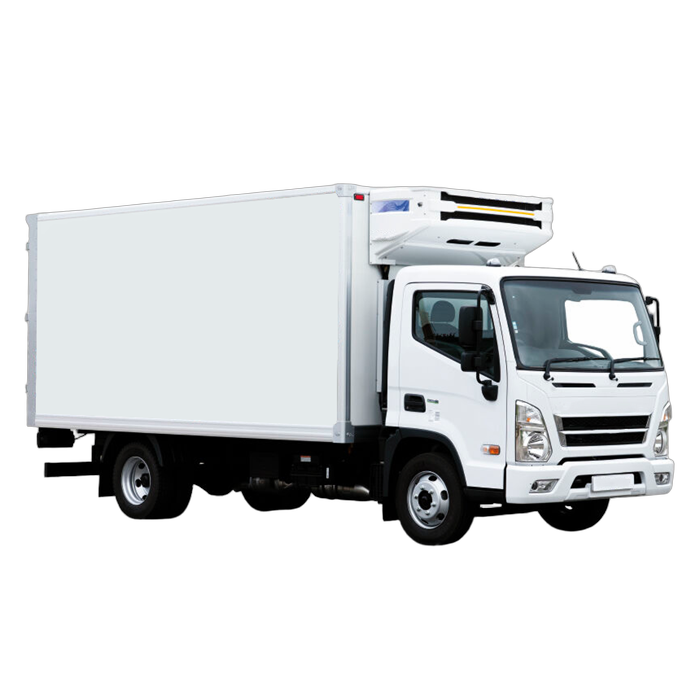
A current Australian example shows the scale. A Hino 300 921 with an eight-pallet freezer body and diesel-drive fridge unit is rated at 8,500kg GVM with a 5,120kg tare. That leaves 3,380kg payload, about 40% of GVM.
Your fridge unit choice also affects the figure. Thermo King says a vehicle-powered V-1000 saves 150kg to 250kg against an equivalent diesel unit. Our guide to choosing between direct-drive and diesel fridge units covers the trade-offs.
Ask each body builder for the weighbridge tare of the finished truck, then subtract it from GVM. That is the only payload figure you can plan around.
What internal dimensions do you need?
Work from internal dimensions, measured between the walls and below the evaporator, not from the external size or a quoted pallet count.
Two standard Australian pallets (1,165mm x 1,165mm) side by side need at least 2,330mm of internal width. Thicker insulation for freezer work reduces internal width for the same outside size.
Two current bodies illustrate the gap:
Body | External width | Internal width | Two Australian pallets side by side? |
|---|---|---|---|
Hino 300 921 eight-pallet freezer body | 2,490mm | 2,380mm | Yes |
Custom 14-pallet freezer body (sold separately) | 2,500mm | 2,270mm | No, below 2,330mm |
The second body may be counted on a different pallet size or loading pattern. That is why you should ask what pallet a quoted count assumes.
For length, allow 1,165mm per row of Australian pallets. The Hino's 5,100mm internal length fits four rows, or eight pallets. Also check internal height against your stacked load, leaving space for air to circulate below the evaporator.
Which doors and access should you specify?
Choose doors around how you unload, then protect the temperature with good seals.
Rear barn doors are standard and suit forklift or pallet-jack loading.
A kerb-side door speeds up multi-drop work, because the driver can pull small orders without opening the whole rear. Several light fridge trucks on sale in Australia come with passenger-side doors.
Seals wear and leak cold air. One seller of a used Hino freezer highlights a five-seal door system, a sign buyers notice door sealing.
Steps and grab handles matter if the driver climbs in at every drop.
Every door opening lets warm air in, so a multi-drop run also needs a unit that recovers temperature quickly.
What do walls, floors and fittings need?
Specify the interior for the product you carry and for any state licence you need.
Lining: for meat, NSW requires the carrying compartment to have durable surfaces that are smooth, impervious and corrosion-resistant. They must also withstand repeated cleaning and sanitising, and not transmit odours or taste. Victoria's PrimeSafe licence requires vehicles to meet the construction requirements of the meat transport standard (AS 4696). If you carry meat or seafood, give these requirements to the body builder up front. Our guide to food transport licences explains which states require one.
Floor: heavy-duty floors such as aluminium chequer plate suit pallet jacks and frequent washing.
Load restraint: specify load-restraint rails at the heights your cartons or crates need. Several current Australian fridge trucks list multiple rails as a feature.
Power: specify the standby socket voltage (240V or 415V) to match your depot.
Ready-built or custom body?
A ready-built body is quicker and usually simpler to price. A custom body fits unusual loads, a set door layout or multi-temp zones.
Ready-to-go bodies are a mature option in Australia. Therma Truck, for example, has imported its Cool Cube bodies for over 10 years. They span 2.4m to 8.0m, are rated for work down to -20°C, and over 1,500 have been sold locally. Dealers also stock trucks already fitted with fridge bodies, which can be ready immediately.
An insulated body can also outlive its chassis. Bodies are sold separately and refitted to new trucks, as long as the chassis rail spacing suits. One 14-pallet freezer body on sale suits rail spacing of 825mm to 950mm. Ask whether your body could be transferred to a later chassis.
What to send body builders before you get quotes
Send the same brief to every builder, so you can compare like for like:
The product and temperature range, chilled, frozen or both
Pallet or crate size, and how many you need to carry
Maximum load weight per run
Number of drops per day and the side you unload from
Door layout, tail lift needs and any shelving
Any licence the vehicle must meet, such as a meat transport vehicle licence
Standby voltage at your depot
A request for internal dimensions, finished tare and lead time in writing
You can compare refrigerated truck and body quotes from Australian suppliers on IndustrySearch by sending one brief to several builders at once.
Frequently asked questions
How thick should the insulation be?
Thick enough to hold your lowest temperature, which means freezer bodies need more than chillers. Ask the builder to quote the panel thickness and the resulting internal width together.
Can I add a side door later?
It is possible but costly, because it means cutting an insulated panel and resealing it. Specify doors at the build.
Does a tail lift affect payload?
Yes. It adds weight at the rear of the truck, so include it in the finished tare.
How long does a custom body take to build?
It depends on the builder's workload and the spec. Ask for a written lead time, and compare it against ready-built stock.
-160x160-state_article-rel-cat.png)
-160x160-state_article-rel-cat.png)